-
tel:
+86-18961602506 -
email:
fly03@flynewenergy.com

FLY
The city of billions of optical storage is about to rise! Zhejiang Ninghai Photovoltaic and Energy Storage Industry Development Seminar was successfully held
Dec 11, 2023
Since entering the "14th Five-Year Plan", technological iterations in the photovoltaic industry and the rapid growth of downstream markets have promoted the intensive implementation of the photovoltaic manufacturing industry. Zhejiang, as one of the representative provinces of photovoltaics in China, has brought together well-known enterprises in all aspects of the photovoltaic industry chain. At the same time, it is also one of the main fronts for the development of new energy sources such as distributed photovoltaics and energy storage in my country. Facing unprecedented development opportunities, Zhejiang Province has taken advantage of its existing industrial advantages and is becoming a high-quality region for attracting project investment and industrial implementation.
Against this background, the China·Zhejiang (Ninghai) Photovoltaic and Energy Storage Industry Development Seminar sponsored by the Ningbo Municipal Committee of the Communist Party of China Talent Work Leading Group Office, Ningbo Investment Promotion Agency, and Ninghai County People's Government was successfully held in Ninghai, Zhejiang on December 7 held.
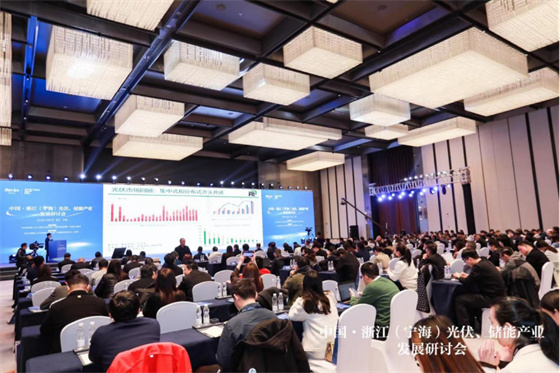
This meeting invited government departments, industry associations and experts, design institutes, equipment manufacturers and other upstream and downstream photovoltaic and energy storage industries to discuss the development opportunities of Zhejiang's new energy industry in the new era. There were about 200 industry guests on site and nearly 10,000 people online. Attended this seminar.
During the speech, Lou Dingding, deputy secretary of the Ninghai County Committee of the Communist Party of China and head of the Ninghai County People's Government, said that in recent years, Ninghai County has been competing for the new energy track, and the output value of the smart photovoltaic industry accounts for more than 50% of the city. The implementation of advanced production capabilities of new energy companies represented by Binzhou and Jiezo has basically formed a full-chain cluster integrating upstream photovoltaic equipment research and development, midstream battery component manufacturing, and downstream energy storage system applications. Ninghai will work together to provide integrated services, accelerate the transformation of cooperation agreements into concrete investments and actual benefits, and strive to create a high-quality business environment that is "Ninghai Satisfactory".
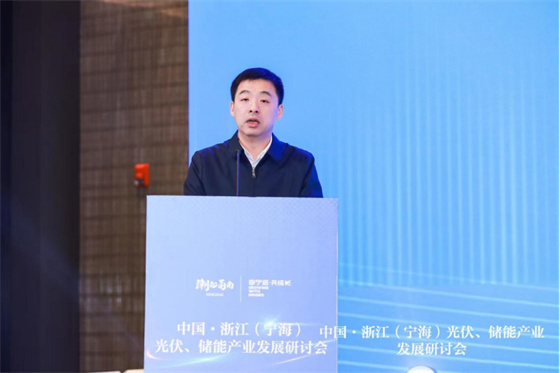
Lou Dingding, Deputy Secretary of the Ninghai County Committee of the Communist Party of China and County Mayor of Ninghai County People’s Government
Pan Yuelong, Chairman of the Board of Supervisors of the China Electricity Council, pointed out that photovoltaics, as the fastest-growing new energy source, has become my country's second largest power source, and Zhejiang Province has completed the "14th Five-Year Plan" two years ahead of schedule with a cumulative scale of 30GW. With the rapid growth of new energy, energy storage is regarded as a key support for building a new power system. However, it still faces pressure and challenges due to the low level of photovoltaic and storage synergy technology and utilization. China Electricity Council will base its functional positioning on the industry, service enterprises, contact the government, and communicate with society to jointly discuss the development plan of the photovoltaic energy storage industry and promote the high-quality development of the energy and power industry.
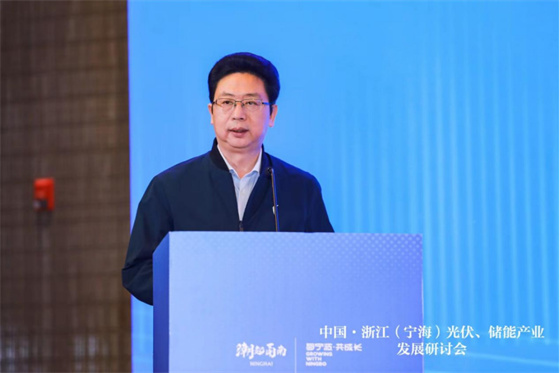
Pan Yuelong, Chairman of the Board of Supervisors of China Electricity Council
New energy policy, market, technology outlook
The rapid development of new energy is inseparable from the planning and support of top-level policies. Zhong Fortune, an associate researcher at the Energy Research Institute of the National Development and Reform Commission, said that as far as photovoltaics are concerned, the policy system framework has been relatively complete, and the future will focus more on the policies of previous years. Some fixes and improvements. New energy electricity prices are an issue of recent concern, including the impact of market-based transactions and coal power capacity pricing mechanisms on new energy income. In terms of production capacity, there may be excess at this stage, but in the long term, there is still a lot of room for growth, both domestically and globally, such as the COP28 meeting and the Sino-US Sunshine Land Statement. It is roughly estimated that there will still be nearly 50% capacity in the next ten years. Hundreds of kilowatts of new space. In terms of energy storage, a series of policies targeting its positioning, dispatching and other aspects have been introduced in recent years. Generally speaking, it is still mainly aimed at serving the new power system of the future. Currently, there are still problems in terms of model and revenue, which will be further improved in the future.
While policy support and a broad market are pushing industry development to new heights, photovoltaic technology is also continuing to advance through constant iterations. Shen Wenzhong, director of the Solar Energy Research Institute of Shanghai Jiao Tong University, pointed out that judging from the existing battery technology, PERC has become a thing of the past, and entering the n-type era is the general trend. At present, TOPCon is the mainstream choice. The reason for its rapid development is that it has the same origin as PERC technology and has the same talents, technology, and equipment. Therefore, after one year of development, it has achieved the same price for n and p. BC technologies can be divided into several types, but the threshold is relatively high, there are relatively few mainstream companies, and industrialization has just begun. Heterojunction technology is the only way to achieve more efficient crystalline silicon cells, but the problem of cost reduction has not yet been significantly broken, and there is still a lot of room for development. Perovskite technology still faces a series of problems such as technical inconsistency, material, size limitations, and cost.
Specific to application scenarios, Ju Xiaolei, secretary-general of the Solar Building Professional Committee of the China Renewable Energy Society, believes that the dual-carbon goals have strict requirements for the construction industry. With the transformation of existing technologies, there will still be more than 1.5 billion tons of carbon dioxide by 2060. It is difficult to neutralize, and there is less and less work that can be done to save energy in buildings, and the cost is getting higher and higher. With the application of building photovoltaics, both neutralization magnitude and cost are superior to existing energy-saving solutions. Preliminary estimates indicate that there will be 500~1,000GW of building photovoltaic demand across the country. However, architectural photovoltaics is still facing problems such as insufficient functional supervision, lack of standards, and difficulty in operation and maintenance. It is recommended that practitioners intervene from the architectural design side as much as possible to achieve synchronized design, synchronized construction, and synchronized operation and maintenance.
Ninghai new energy layout
During the Ninghai investment environment promotion session, Li Wenbin, director of the Ninghai County Investment Promotion Center, introduced that three main tracks have been formed: "photovoltaic + energy storage", "mold + new energy auto parts", and "culture and sports + office", as well as new materials , high-end equipment manufacturing, biopharmaceuticals and other subdivided tracks. In particular, the "photovoltaic + energy storage" track is the first industry that Ninghai is cultivating and growing. It has been selected into the first batch of "Made in Zhejiang" provincial characteristic industrial cluster collaborative zones. The goal in the next few years is to build a 100-billion-level industrial cluster. Create a national advanced photovoltaic energy storage industry innovation highland and a green and intelligent manufacturing highland with distinctive Yangtze River Delta characteristics.
In addition, Ninghai also has two provincial economic development zones and two professional parks, which serve as important platforms for the gathering and development of industries and talents. Among them, Ningbo Southern Binhai Economic Development Zone and Ninghai Economic Development Zone are the main spaces for the implementation of optical storage projects. Ninghai Photovoltaic Energy Storage Provincial High-tech Industrial Park has been successfully approved as a Zhejiang Provincial High-tech Industrial Park.
Li Wenbin emphasized that Ninghai will welcome enterprises to settle in Ninghai with its first-class business environment, strong supporting policies and thoughtful comprehensive services.
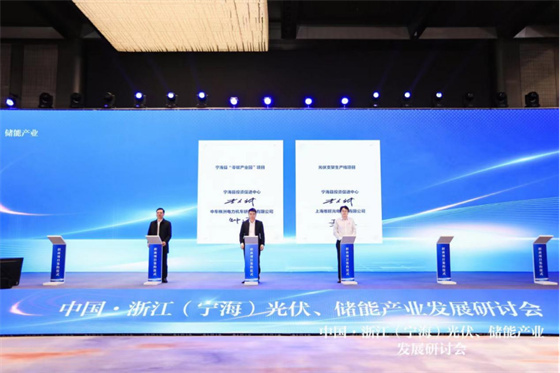
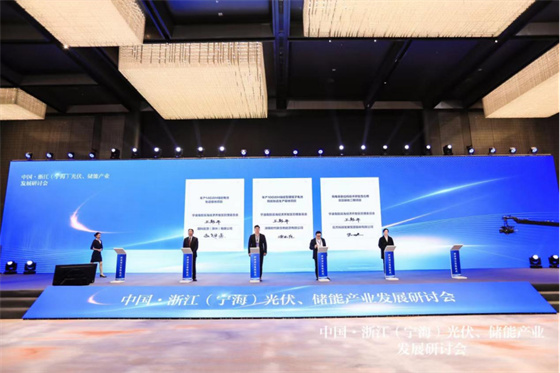
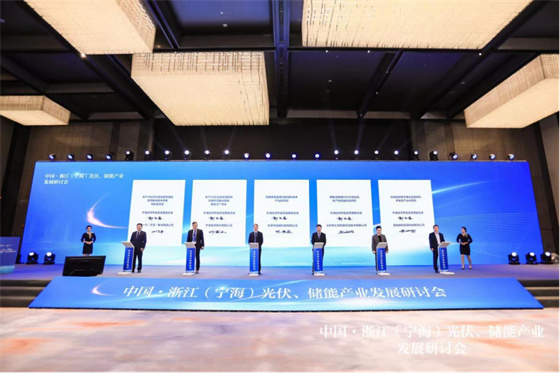
Signing site
A project signing ceremony was also held at the meeting. Ten projects including new energy storage, new energy intelligent warehousing and logistics handling equipment, high-precision metal injection molding, lithium battery module PACK automated production line, and high-performance sodium-ion battery cathode materials were launched in Ninghai.
Double carbon era
Although the development prospects of new energy are promising, the safety issues caused by the penetration rate of the power grid as the installed capacity continues to grow also require the industry to pay close attention. Sun Peijun, a consultant at the General Institute of Electric Power Planning and Design, pointed out in the report that in July this year, the national level proposed a scientific and rational design of new power system construction paths. On the basis of safe and reliable substitution of new energy, there are plans to gradually reduce the proportion of traditional energy in a step-by-step manner. It is necessary to improve the systems and mechanisms that adapt to the new power system, and promote the strengthening of power technology innovation, market mechanism innovation, and business model innovation.
Sun Peijun believes that the construction of new power systems must continuously improve the reliable substitution capabilities of new energy through innovative development methods such as system-friendly power stations, source-grid-load-storage integration, energy+, and long-term energy storage. New energy power must not only fully meet the rigidly growing national electricity demand and accelerate the replacement of existing fossil power consumption, but also gradually increase the proportion of new energy in the power balance and have the ability to operate with stable output and base load to replace fossil power installed capacity and be able to proactively Provide support capabilities such as frequency adjustment, inertia support, and voltage adjustment to ensure safe and stable operation of the system, and gradually replace fossil power sources in terms of power, electricity, and support for safe and stable operation.
In terms of the development of the new energy storage market, according to Ning Na, senior research manager of the Zhongguancun Energy Storage Industry Technology Alliance, in the first three quarters, the installed capacity of newly put into operation in China was 13.2GW, +87% year-on-year, of which new energy storage projects The scale of new operational installed capacity is 12.3GW/25.5GWh, and the scale of new planned and under-construction new energy storage projects is 102.8GW/240.8GWh. If 10% can be completed in the fourth quarter, the domestic installed capacity during the year may reach 49.6GWh, three times the installed capacity last year. level. At the same time, bidding competition among energy storage companies has been fierce this year. In September, the average bid price of energy storage systems fell below 1 yuan/Wh, energy storage cells were quoted below 0.5 yuan/Wh, and 0.5C energy storage systems were quoted below 0.7 yuan. /Wh quote.
Regarding the development trend of energy storage in the future, Ning Na mentioned that no matter whether the energy storage power station is installed on the transmission side or the distribution side, whether it is a shared station with a renewable energy site or an energy storage power station independently connected to the power grid, it will mainly derive its power from electricity. The market benefits and multiple benefits are obtained. In the past year, China's energy storage technology has developed rapidly and is undergoing a transition from the early stage of commercial development to large-scale development. In the new year, large-scale energy storage will become the norm.
Opportunities and challenges in the new energy era
Facing the energy revolution under the dual-carbon goals, the construction of a new power system dominated by new energy has given photovoltaic, energy storage and other industries huge room for development, but at the same time it also faces a series of challenges. Qi Haifeng, deputy director of the East China Survey and Design Institute of China Power Construction Corporation, said that Zhejiang Province has strong momentum of renewable energy development and will rely on its rich marine resources to promote offshore wind power and offshore photovoltaics and actively lay out green energy industrial parks. However, the problem of consumption is still a key obstacle to the development of new energy. From the perspective of design institutes, more consideration is given to the development model of integrated water, wind and solar energy.
Lu Jinbiao, deputy director of the Expert Committee of the Silicon Industry Branch of China Nonferrous Metals Industry Association, pointed out from the perspective of the industrial chain that overcapacity is only temporary. Although the scale of production expansion in each link is huge, the overall situation still depends on the actual implementation. Industrial development is still at a The benign stage is precisely why the rapid progress of battery technology has been promoted. If the timeline is extended, the current situation may be the best. The current low-price competition is more of a strategic issue. As the new year begins, the rhythm may change. As for next year, it still depends on the development strategies of leading companies. From a price perspective, the price of silicon materials may be stable at around 60,000 to 70,000 yuan/ton.
Zhuang Yinghong, global marketing director of Risen Energy Co., Ltd., said that the photovoltaic industry has been criticized for overcapacity for more than ten years, but advanced production capacity has never actually been overcapacity. The current price competition is relatively fierce, and Risen Energy's differentiated route that favors heterojunctions may have certain advantages, and it will increase its energy storage layout next year.
Qiu Chengfeng, general manager of Shuangyili Energy Storage, a subsidiary of Risen Energy, said in a roundtable dialogue that energy storage and photovoltaics have similar development histories and complement each other. Although the energy storage market started late, it has developed more rapidly. In just a few years, it has reached the annual global installed capacity of 100 GWh and will continue to grow strongly. At present, the income models of domestic large-scale reserves are gradually enriched, and the profit space of the industrial and commercial market is further broadened; in overseas countries such as Europe and the United States, Shuangyili has also occupied an advantageous share. At the same time, the company has also launched self-developed EMS, BMS, and PCS systems to promote sustainable and high-quality development, and is committed to becoming the world's leading full-scenario energy storage system solution service provider.
Zhejiang Optical Storage Application Trend
As photovoltaics account for an increasing share of my country's power generation system, "photovoltaics + energy storage" has also ushered in a broad market. Energy storage has the characteristics of flexibility, two-way adjustment, and the photovoltaic + energy storage power generation mode has many advantages such as rapid response to grid frequency regulation, which can create a safer and more reliable photovoltaic power generation scenario. At the meeting, Dr. Jia Yanbo, a postdoctoral fellow at the East China Survey and Design Institute of Power Construction Corporation of China, shared the development prospects and technical applications of optical storage from the aspects of new energy development background, photovoltaic and energy storage development models, key technologies, and engineering practices. In the context of global energy transformation, "photovoltaic + energy storage" will be one of the inevitable trends in the development of the new energy power market in the future.
Energy storage has developed rapidly in the past two years. As a typical application of distributed energy storage systems on the user side, industrial and commercial energy storage can effectively increase the consumption rate of clean energy. At the meeting, Chen Yinghai, marketing director of Shuangyili (Ningbo) Battery Co., Ltd., shared the analysis and technical application of the industrial and commercial energy storage market. Director Chen said that the global energy storage market will maintain a rapid growth trend, and the enthusiasm for investment in energy storage has increased under the influence of factors such as the dual-wheel drive of the domestic market and foreign markets, and the reform of the domestic power market. At the same time, there are also pain points in the industry such as uneven levels of upstream supply chains and serious homogeneity. As a supplier of "energy storage +" smart energy systems, Shuangyili is a high-tech enterprise integrating R&D, production, sales and service. It has advanced advantages in energy storage battery technology. In the future, we will continue to optimize product design, reduce overall investment costs through independent research and development of 3S, establish brand coverage and customer stickiness, improve delivery and operation and maintenance systems to enhance user experience, and create localized services.
As an important supporting technology for the construction of new power systems, energy storage has attracted widespread attention from people inside and outside the industry. At the meeting, Yikang, Director of the Solutions Department of the Integrated Energy Business Department of CRRC Zhuzhou Institute, shared the key technologies and application practices of CRRC Zhuzhou Institute’s energy storage system. Minister Yi said that overseas energy storage applications are now mature. The main battlefield for large-scale storage is in North America, and household energy storage is standard in Europe. The entire energy storage industry is showing a trend of rapid product iteration, large-capacity batteries driving down the cost of energy storage systems, and the market continuing to decline. CRRC's energy storage products have technical advantages such as high safety, high efficiency, grid friendliness, and intelligence. They comprehensively ensure the safety of industrial and commercial energy storage from "electricity + structure". The design of thermal management + independent PCS not only extends the life of the energy storage system. life, reduces system power consumption, and greatly improves system efficiency. It is widely used in large storage, industrial and commercial energy storage and other scenarios.
He Song, R&D Director of Jiezao Technology (Ningbo) Co., Ltd., shared VHF straight-through mass production PECVD equipment and technology for microcrystalline heterojunction cells, and introduced Jiezao from four aspects: PECVD, PVD, cleaning and texturing section, and screen printing section. Technical characteristics of manufacturing technological equipment. As a pan-semiconductor technology high-end equipment company, Jiezao Technology has rich technology accumulation and a large number of successful delivery cases in the field of vacuum thin film deposition equipment, and has more than 10 years of experience in solar cell equipment preparation. In particular, it has advanced technology of PECVD, the core equipment of the photovoltaic heterojunction cell production line, low-damage magnetron sputtering PVD equipment, and experience in manufacturing, delivery, operation, maintenance and technology upgrades of GW-level equipment. On November 5, Jiezo Technology officially delivered the 1GW heterojunction cell production line at Risen Energy's Nanbin base.
Create a new energy industry highland
With the advent of the N-type era, the battle for battery technology routes has intensified, and the development of future photovoltaic technology paths has attracted much attention. At the meeting, Song Yifeng, product director of Risheng Oriental New Energy Co., Ltd., discussed this. Heterojunction has the advantages of high conversion efficiency and low temperature coefficient. Therefore, during the iteration of battery technology, Risen Energy has been focusing on the research of heterojunction technology. The heterojunction Fuxi products developed have completely independent patented technologies, including busbar-less battery technology, ultra-thin battery technology, pure silver dosage <9mg/W, and liter-connection stress-free battery interconnection technology. As the world's leading new energy company, Risen Energy leads the global energy revolution with its solar modules, photovoltaic power stations, etc. In the future, it will continue to help customers achieve "low-carbon" or "zero-carbon" goals through products and help the whole society enter the The era of carbon neutrality!
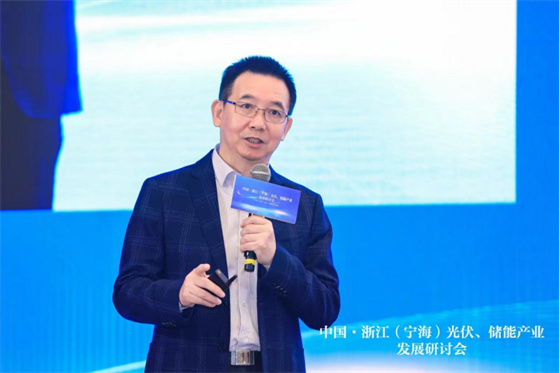
Yang Deren, Academician of the Chinese Academy of Sciences and President of Zhejiang University Ningbo Institute of Technology
In recent years, the national level has issued a series of policies to encourage the development of the photovoltaic industry. Driven by policies and domestic photovoltaic technology, photovoltaic silicon materials have developed rapidly as an important link in the photovoltaic industry chain. Yang Deren, academician of the Chinese Academy of Sciences and president of Zhejiang University Ningbo Institute of Technology, shared the development and challenges of the photovoltaic silicon material industry. Speaking of which, after years of development in China, domestic photovoltaic silicon wafer manufacturers have more advantages than overseas companies in terms of cost control and product performance. The focus of production capacity in all aspects of the photovoltaic silicon material industry has shifted to China. However, in the past two years, the production capacity of the domestic high-purity polysilicon industry has continued to expand, presenting a highly concentrated competitive landscape among leading companies, resulting in overcapacity. Therefore, in the fierce market competition, the healthy and sustainable development of the industry is very important.
Recent Posts





Contact US
Product Information
Quantity
Unit
Piece
Support order samples, customization, wholesale direct, and complete payment. If the product you look for does not have corresponding customized content, pls fill out the form below to contact us, and we will reply ASAP.