-
tel:
+86-18961602506 -
email:
fly03@flynewenergy.com

FLY
Patent wars are raging, and "conspiracies" and "conspiracies" in the lithium battery arena
Oct 31, 2023
With the rapid development of the new energy industry and the continuous breakthroughs in lithium battery technology, the intellectual property wars between enterprises have continued to escalate and become increasingly fierce. Recently, patent wars between many lithium battery companies have appeared frequently in the market. This year, after two rounds of patent lawsuits involving domestic lithium battery separator Enjie Co., Ltd. involving 280 million yuan were launched this year, Jinli Co., Ltd.’s IPO failed in late September on the Science and Technology Innovation Board. In October, the ZTE New Materials Science and Technology Innovation Board IPO in the diaphragm field was also terminated.
The current global power battery market is divided into three parts: China, Japan, and South Korea, with China, Japan, and South Korea accounting for more than 90% of the market share. In recent years, Europe and the United States have vigorously developed the electric vehicle industry and battery industry, and are also actively attracting battery factories from China, Japan and South Korea to start production in their own countries. However, in order to protect their local battery industries, Europe and the United States have also formulated protection and support policies, including Asian companies, including Chinese companies, will have a certain impact on the European and American markets or building factories in Europe and the United States. Under a new round of competition in the global battery field, the power battery industry may face a rearrangement.
Opportunities and challenges coexist
The development of China's lithium battery industry presents both opportunities and challenges. On the one hand, globalization and technological innovation bring a broader market; on the other hand, we face foreign patent barriers, litigation and fierce business competition.
The pros and cons of industry development
Driven by the dual carbon goals, the global new energy market has great growth potential. Domestic and foreign battery companies continue to release large-scale production capacity expansion plans, and some car companies build part of their own battery production capacity. In September this year, Tianqi Lithium announced that it had signed a strategic cooperation agreement with Geely Holding. The two parties will carry out in-depth cooperation in multiple fields such as upstream resources, core materials, lithium battery technology research, new energy vehicle lightweight materials, and software technology development. NIO is preparing to establish a joint venture with power battery company Honeycomb Energy to jointly develop large cylindrical batteries. Last year, Yiwei Power, a subsidiary of Yiwei Lithium Energy, signed a strategic cooperation agreement with Dayun Motors. Dayun Motors will assemble Yiwei Power 46 series large cylindrical batteries on Yuanhang brand models, and comprehensively integrate Yiwei Power into new energy commercial vehicles. Cooperation. In addition, domestic and foreign car companies such as BYD, GAC, Great Wall, and Tesla are also developing their own lithium battery technology.
In the long run, deepening cooperation between car companies and lithium battery companies will help each to leverage its technological advantages, integrate resources, and jointly promote the development of lithium battery technology. This also confirms from the side that the development of new energy has intensified competition between the automotive industry and the lithium battery industry, and manufacturers in the industry are not willing to lag behind in cooperating in the research and development and production of power batteries.
Companies going overseas face “patent walls”
Today, the domestic lithium battery market is gradually saturated, while the penetration rate of new energy vehicles abroad is not high. For power battery companies, overseas markets are expected to have room for several-fold growth. Lithium battery companies are constantly impacting overseas markets and accelerating industry globalization. The latest data released by the Ministry of Industry and Information Technology shows that in the first half of this year, the national lithium battery production increased by more than 43% year-on-year; the industry's revenue reached 600 billion yuan, and the export value of products increased by 69% year-on-year. It is reported that most of the lithium batteries exported in the first half of the year were power batteries.
According to incomplete statistics, as of July this year, more than ten Chinese power battery companies, including CATL, Honeycomb Energy, Guoxuan Hi-Tech, Envision Power, Everview Lithium Energy, Sunwoda, and China New Aviation, have announced overseas investments. plan. CATL’s semi-annual report shows that its overseas revenue in the first half of the year reached 67.169 billion yuan, nearly 90% of last year’s overseas revenue.
At present, the overseas layout of domestic enterprises is mainly aimed at Europe, the United States, Japan and South Korea. However, my country's lithium battery industry started relatively late. Except for the negative electrode, the patent layout of other materials is more or less lagging behind European, American, Japanese and Korean companies. As European, American, Japanese and Korean companies take advantage of their own technology first-mover advantages, they have built up a high wall of core patents for lithium batteries. Most of the patents applied by foreign companies are basic patents, which are also patents that are difficult for domestic companies to circumvent during the R&D and production processes. In terms of cathode materials, 3M Company of the United States and Hydro-Quebec of Canada have always monopolized the patents of ternary and LFP; Japanese companies have registered basic patents for electrolytes and separators.
global litigation crisis
As technology matures and markets develop, companies continue to expand product categories to cope with market competition. In this race that concerns the life and death of companies, intellectual property rights play an important role in the global lithium battery industry chain. As mentioned above, the patent walls built by foreign technology pioneers not only block the expansion of domestic companies' patented technology routes, but also bring patent litigation crises to companies.
Today, patent litigation among domestic lithium battery companies is already in full swing. In the global industrial chain, with the technological advancement and market development of Chinese lithium battery companies, some leading lithium battery companies have been challenged by patents from foreign lithium battery companies. As is familiar to the industry, American lithium battery separator giant Celgard, Belgian Umicore, Japan's Asahi Kasei, Japan's MAXELL, South Korea's LG, domestic CATL, Zhuhai Guanyu, Rongbai Technology, Xingyuan Materials and other companies are conducting operations in different countries and battlefields. patent war. After the industry enters the Red Sea, the survival space of enterprises becomes smaller and smaller. Amid technological innovation and fierce market competition, global litigation by domestic and foreign enterprises is inevitable.
Lithium batteries have entered the patent war
Especially since this year, patent disputes in the domestic lithium battery industry have broken out intensively. First, Zhuhai Guanyu, a domestic power battery manufacturer, continued to compete with ATL, and then the patent litigation and technical secrets of companies in the fields of cathode materials, lithium battery separators and electrolytes continued to collide. In response to the increasingly frequent patent litigation involving lithium batteries, industry insiders pointed out that intellectual property disputes over lithium batteries have broken out across the entire chain.
Power battery manufacturers are at the center of the patent war
With the explosive growth of new energy vehicles in the past two years, patent litigation, technical secret disputes, unfair competition, etc. have become an important manifestation of technological competition and market competition among lithium battery manufacturers. Power battery and consumer battery manufacturers, which are in the "center" of the lithium battery industry chain, cannot escape the "whirlpool" brought about by this industry competition.
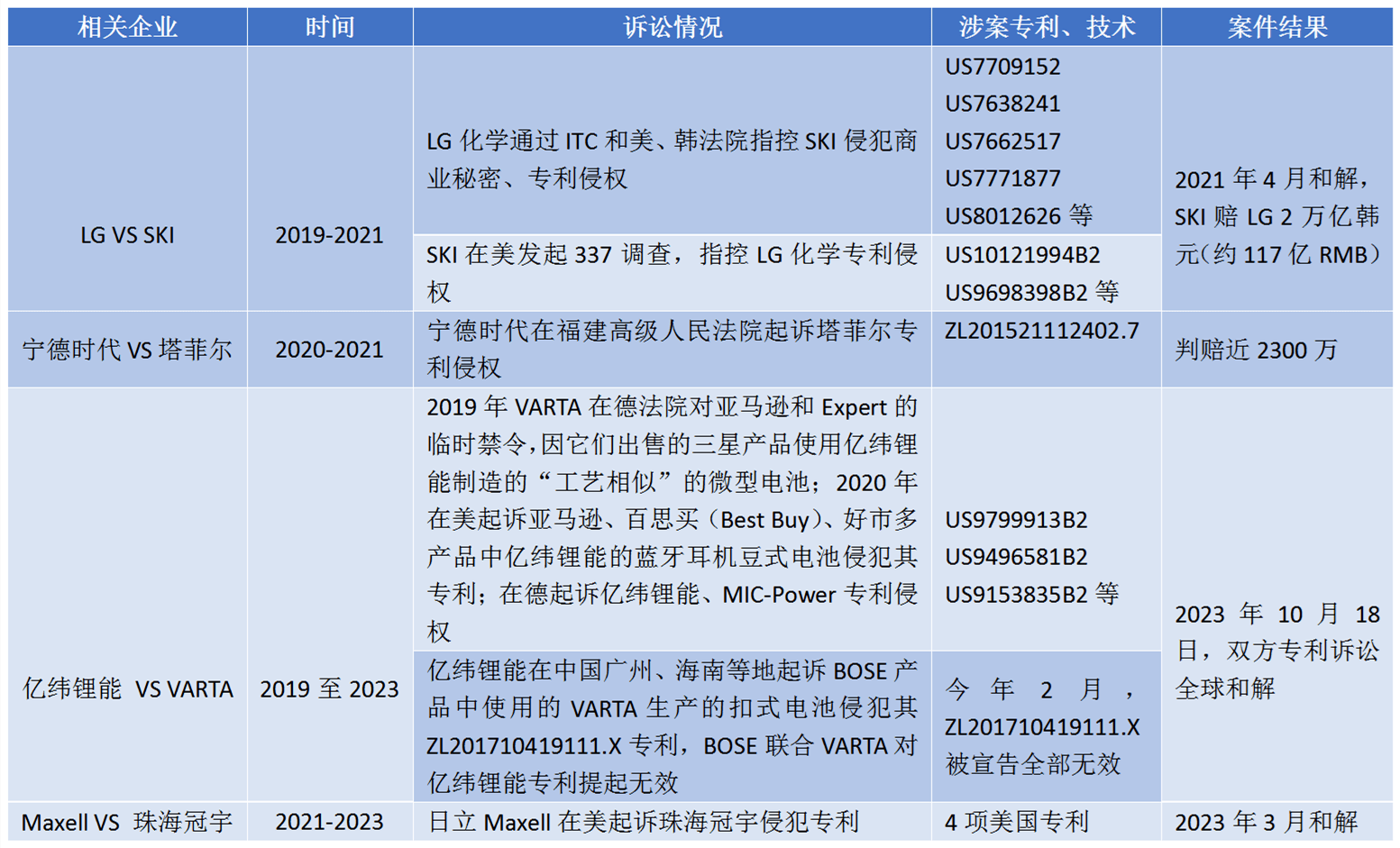
The patent wars among enterprises reflect the fierce competition in the industry market. As mentioned above, one of the reasons for the battle between the two giants LG and SKI is that in 2018, SKI defeated LG to become the Volkswagen Group's power battery supplier in the United States and reached a multi-billion-dollar agreement with Volkswagen. The industry believes that the multi-year patent war between Germany's VARTA and Yiwei Lithium Energy was started by VARTA to combat Yiwei Lithium's sales and market in the United States.
Intellectual property litigation among domestic power battery manufacturers has also reached a feverish stage. The most intuitive manifestation is that the power battery leader CATL continues to have intellectual property disputes with leading domestic lithium battery manufacturers such as Tafel, Lixin Energy, China New Aviation, and Honeycomb Energy. Property disputes. In addition, the patent attacks on technology companies during the financing process will have an important impact on the listing results. Tafel finally terminated the listing process due to a patent dispute with CATL.
On the other hand, the domestic consumer battery field has also been frequently challenged by patents from foreign companies. For example, Zhuhai Guanyu also suffered a patent lawsuit from Hitachi Maxell during the IPO, but the two parties eventually reached a settlement. However, Zhuhai Guanyu and ATL have been involved in multiple patent disputes in China, the United States and Europe since 2021.
Lithium battery upstream material patent litigation is in full swing
Cathode materials, anode materials, separators, and electrolytes are the four core materials of lithium batteries. In recent years, related companies have had technical and patent frictions with domestic and foreign companies.
At present, most of the patent lawsuits encountered by well-known domestic companies in the upstream of lithium batteries occur in the fields of cathode materials, separators and electrolytes. For example, in the field of cathode materials, the Belgian company UMICORE has successively launched patent lawsuits against Dangsheng Technology, Rongbai Technology and other companies, but most of UMICORE ended in failure.
In the separator field, Xingyuan Materials is competing against the American company Celgard (acquired by Japanese separator giant Asahi Kasei) and the domestic ZTE New Materials. This year, domestic Enjie shares faced off against Jinli shares again. I don’t know whether it was due to the huge lawsuit that put some pressure on Jinli shares. Recently, its IPO on the Science and Technology Innovation Board came to an abrupt end.
In the field of electrolytes, the "Ningwang" product was accused by the Japanese company MU Ionic in Europe of infringing on electrolyte-related patents, and the domestic electrolyte leader Tianci Materials also initiated a lawsuit against Jinshi Resources for infringement of technical secrets.
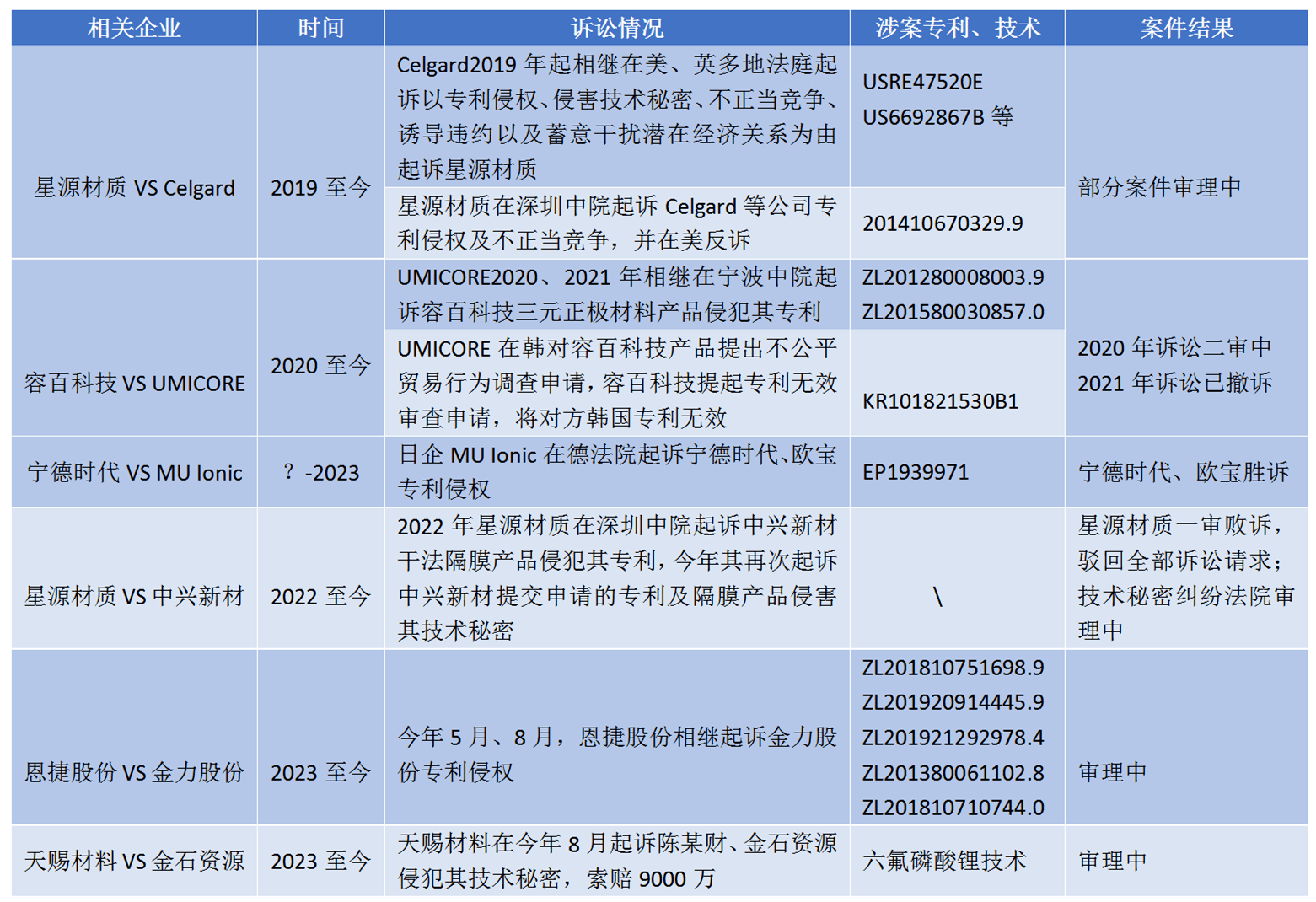
With the rise of the domestic new energy industry and the development of overseas markets, intellectual property litigation for lithium batteries is spreading to various segments. The increasingly tense patent wars between lithium battery manufacturers in the middle reaches of the lithium battery industry chain will often affect downstream electric vehicle manufacturers and related application companies in the consumer industry. At the same time, the patent and technology competition in the upstream lithium battery material field has become increasingly fierce.
Among the heroes vying for the throne, who is in control?
Now, the basic patent of lithium iron phosphate has expired in 2017, and the remaining carbon coating and carbothermal reduction patents have expired in 2022. Now the overseas development of domestic lithium iron phosphate will be much smoother [6]. In order to ride on the east wind of the development of the new energy vehicle industry, how Chinese power battery companies can break through the shackles of technological blockade, patent litigation, industry challenges, etc. is worth looking forward to and discussing.
Not afraid of challenges and actively respond to complaints
Although the patent war for lithium batteries is already raging, it can be predicted that with the development of low-carbon economy and the take-off of new energy vehicles, intellectual property disputes in the industry may become more acute in the future. Most of the current patent wars have been resolved in the form of settlement, and there are also many domestic cases in which compensation has been awarded. For example, industry patent wars between LG and SKI, Maxell and Zhuhai Guanyu, and CATL and Honeycomb Energy eventually ended in settlement. CATL also received a compensation of nearly 23 million yuan in a lawsuit against Tafel. In the battle with ATL, Zhuhai Guanyu was awarded more than 80 million yuan in damages in the first instance. However, with the invalidation of relevant patents and appeals filed by relevant parties, the amount of damages and the battle situation between the two parties may change.
But it seems that the intellectual property disputes in the industry are facing a situation of "one wave after another". For example, this year, Xingyuan Materials in the diaphragm field just went to court with ZTE New Materials for infringement of technical secrets. Soon after, Enjie The company and Jinli Co., Ltd. had two more patent wars, and then Tianci Materials, a company in the electrolyte field, sued Jinshi Resources, the leader in the domestic fluorspar industry.
However, after rounds of market competition and technology competition, companies have grown through the tempering of patent wars, and more and more markets can draw experience in rights protection and litigation response from numerous cases. Faced with the inevitable intellectual property disputes in the market, actively suing or responding to lawsuits in court has become a way for companies to counterattack directly to face challenges. When faced with the lawsuit initiated by Celgard, Xingyuan Materials also filed an infringement lawsuit against Celgard in China and gained the upper hand in the battle. Yiwei Lithium Energy was also not to be outdone in the battle against VARTA. In addition to invalidating each other's patents, it also filed a patent lawsuit against the other party.
By licensing, bypass the industry's basic patents
Currently, patent licensing has become an important way for many companies to establish industry cooperation and settlement conditions. Although companies may need to pay large patent licensing fees, in terms of missing first-mover advantages and long-term development of the company, domestic lithium battery companies can resolve existing lawsuits or bypass other countries’ lithium licenses through patent licensing and cross-licensing. Basic patents in the battery field.
Today, many companies in the industry have broken through the "patent walls" formed by industry first movers through licensing. For example, Tianci Materials has introduced the lithium hexafluorophosphate manufacturing technology of Dr. Novis Smith of the United States through technology licensing and built a 300-ton/year production line, solving the risk of relying on outsourcing of core raw materials; Defang Nano obtained a Swiss company in 2019 LiFePO4+C LICENSING AG licenses the lithium iron phosphate carbon coating technology and its production process, paving the way for products to go overseas; the separator king Enjie Co., Ltd. also agreed with Teijin of Japan to use the latter’s PVDF solvent-based coating materials Relevant patents, as well as patents related to the phase separation coating production process, are exclusively licensed to Enjie for use.
Increase R&D and innovation to enhance product quality and performance
Facing new challenges, companies should further increase product research and development and innovation, and improve the environmental protection and performance of lithium battery products. At the same time, enterprises should strengthen overseas investment and cooperation with overseas customers to expand the scale of the international market and consolidate their market position.
In April this year, China Innovation Aviation released a "top-class" cylindrical battery. Its 2022 annual report introduced that the "top-class" cylindrical battery is based on another innovation of China Innovation Aviation's One-Stop minimalist design, through self-developed structural innovation. Innovated with a chemical system, it achieves a significant improvement in battery performance compared to traditional cylindrical batteries. Zhuhai Guanyu has also increased its research and development and layout of power batteries. It revealed in its 2023 semi-annual report that its solid-state metal lithium battery technology materials have prepared solid-state battery samples with an energy density of up to 350Wh/kg and have good safety performance. and cycle life, and Zhuhai Guanyu’s power battery electrolyte technology has been introduced into mass production.
Pay attention to international market trends and enhance compliance when going overseas
Looking at the current situation, Chinese companies have encountered new barriers to going overseas. On August 17 this year, the new EU battery regulations "Battery and Waste Battery Regulations" officially came into effect. According to this regulation, starting from July 2024, power batteries and industrial batteries must declare product carbon footprints. At the same time, starting from 2027, power batteries exported to Europe must hold a "battery passport" that meets the requirements, recording battery manufacturer, material composition, recyclables, carbon footprint, supply chain and other information. Some analysts believe that this will have a significant impact on Chinese power battery companies' exports to Europe.
A series of measures at home and abroad have put forward higher requirements for enterprises to comply with laws and regulations, safety, standards, quality, environment, information, etc. It is reported that Yiwei Lithium Energy has established a foreign-related compliance team to manage foreign-related legal work and overseas investment project support at its headquarters and global subsidiaries, and participate in cross-professional and cross-field projects (such as GDPR compliance projects). CATL's compliance management department carries out risk identification and assessment based on laws and regulations, business models, external environment, etc. to determine its own compliance obligations and next steps. When going overseas, domestic companies have basically set up legal teams to manage compliance practices. However, as the overseas market environment becomes increasingly stringent on battery company production and operation standards, companies should further strengthen foreign-related compliance management and risk prevention.
Develop batteries with other chemical systems to achieve lane changing and overtaking
Today, the application of lithium batteries is the mainstream of the power battery market. In the past, European, American, Japanese and Korean companies took advantage of technology first movers to build a wall of core patents for lithium-ion batteries, which provided experience and reference for the development of Chinese companies in the field of power batteries. In order to have a say in the industry in future development, in addition to continuing to strengthen research on lithium batteries, it is also necessary to lay out forward-looking technologies early, innovate other chemical system batteries and their materials, and register patents first.
For example, although research in the field of sodium-ion batteries originated very early, the unstable material structure has become a bottleneck that has hindered its commercialization. At present, in terms of research on sodium-ion batteries, Chinese, Japanese, Korean, European and American companies are standing on the same starting line, which provides a path for Chinese companies to overtake in a corner.
The "Nihon Keizai Shimbun" website reported that in the field of sodium-ion batteries, which is the focus of various countries, the number of patents obtained by China far exceeds that of Western countries such as the United States. As of December 2022, the total number of valid patents in this field is 9,862, of which 5,486 are from China, with seven institutions including China’s Chinese Academy of Sciences and CATL ranking among the top ten. However, although Japan and the United States lag behind in the overall number of patents, they still have some technological advantages. For example, Japan ranks first in the comprehensive evaluation of patents related to "fluoride ion batteries" that are expected to be used in pure electric vehicles. The United States ranks first in the "magnesium ion battery" project. In addition to sodium-ion batteries, there are also batteries with different electrochemical systems such as potassium-ion batteries, lithium-sulfur batteries, solid-state batteries, etc. In the process of alternation between old and new energy systems in the world, the use scenarios and potential of these batteries are infinite. The future of global power batteries may be reshuffled in a new round of technology competition.
Recent Posts

Contact US
Product Information
Quantity
Unit
Piece
Support order samples, customization, wholesale direct, and complete payment. If the product you look for does not have corresponding customized content, pls fill out the form below to contact us, and we will reply ASAP.