-
tel:
+86-18961602506 -
email:
fly03@flynewenergy.com

FLY
What are the challenges and opportunities facing the Australian battery energy storage market?
Aug 01, 2023
According to a research report released by research firm Wood Mackenzie at the Australian Clean Energy Summit held in Sydney, Australia ranks at the forefront of the global battery energy storage market, and the country has announced that the total installed capacity of energy storage projects that have been deployed exceeds 40GW.
Kashish Shah, senior research analyst at Wood Mackenzie, said, "The surge in renewable energy generation in recent years and the highly competitive market design have made Australia one of the most attractive grid-scale energy storage markets in the world. The wholesale market and frequency control market provide diversified revenue streams for battery energy storage systems, and the substantial funding provided by the Australian government provides income certainty for energy storage projects. The installed capacity of energy systems will increase by 28%.”
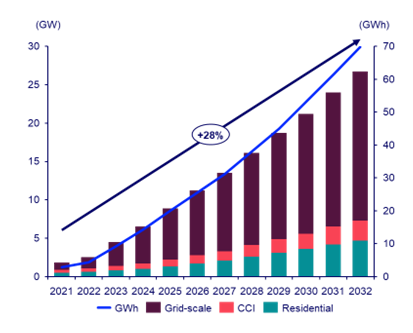
Prices of energy storage systems and batteries expected to drop in Asia Pacific
With energy storage projects deployed in Australia mainly targeting the high-value frequency control and ancillary services (FCAS) market, grid-scale battery energy storage systems with a duration of two hours are currently the mainstream energy storage technology. By 2032, the prices of lithium iron phosphate batteries (LFP) and NMC ternary lithium-ion batteries are expected to drop by more than 40%. This in turn will drive battery storage system costs down 18% to 21% over the next decade, making it the biggest driver of capital spending cuts.
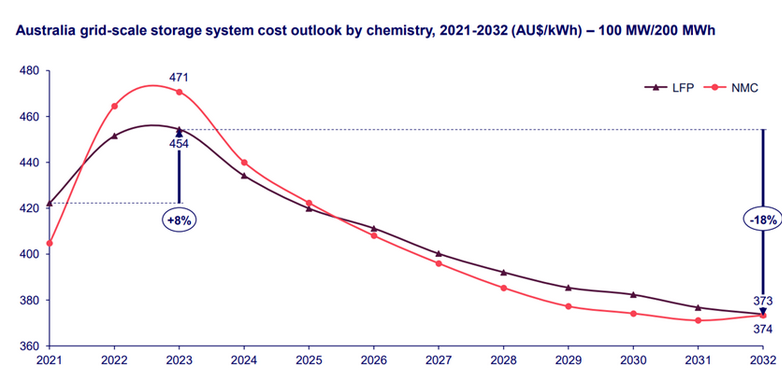
The current downward price trend for batteries is due to slower growth in electric vehicle (EV) demand and low lithium prices, which have fallen by almost 46% since November 2022. The increase in production capacity is expected to lead to further declines in energy storage system prices by 2025. Wood Mackenzie expects that falling commodity prices and technological advances will also lower battery prices in the coming years.
In contrast, the cost of grid-scale battery energy storage systems in Australia is 30% to 40% higher than that in China (the price of battery energy storage systems in China is the lowest), and the cost is expected to drop by 50% by 2032. Abundant component manufacturing and fierce market competition will mean that the cost of battery energy storage systems deployed in China will fall faster than any other country and region in the world.
Shah added, “Battery energy storage system costs in China benefit from a booming domestic supply chain, while Australia and South Korea’s reliance on imported batteries will continue to be a bottleneck. In addition, higher labor wages in Australia will mean higher EPC costs, This will dilute the benefits of lower battery storage costs."
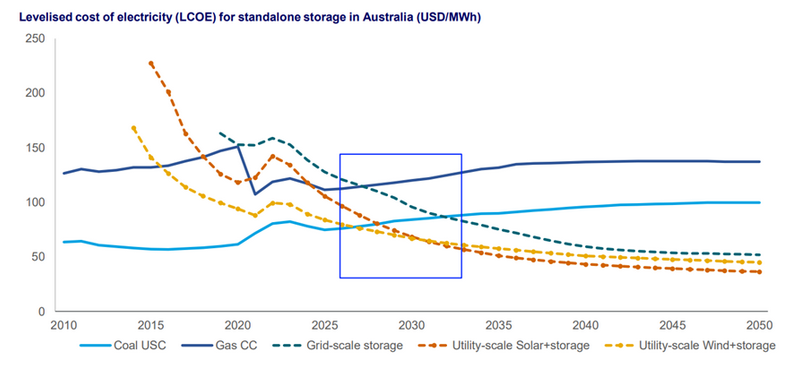
Cost per unit of electricity for independent deployment of energy storage systems in Australia
Currently, the level-of-energy cost (LCOE) of grid-scale energy storage systems deployed independently is still high compared with other dispatchable generation facilities, but according to Wood Mackenzie's survey, by 2032, the cost of energy storage systems will be greatly reduced. The competitiveness of natural gas power generation.
Looking ahead, Wood Mackenzie expects that by 2028, the cost of renewable energy + energy storage projects will weaken the competitiveness of coal-fired power generation and natural gas power generation costs, and the installed capacity of battery energy storage systems deployed in the Australian market will accelerate by then.
However, there are some challenges and obstacles in the way of energy storage deployment in Australia. For example, connecting the grid in a timely manner at the desired location is a big challenge. The cost of building substations is high, accounting for about 12% to 13% of the total capital expenditure of the power grid. Overall, however, battery costs remain a continuing challenge for the Australian energy storage market compared to other countries in the Asia-Pacific region.
Recent Posts

Contact US
Product Information
Quantity
Unit
Piece
Support order samples, customization, wholesale direct, and complete payment. If the product you look for does not have corresponding customized content, pls fill out the form below to contact us, and we will reply ASAP.