-
tel:
+86-18961602506 -
email:
fly03@flynewenergy.com

FLY
Working principle of residential energy storage
Nov 28, 2022
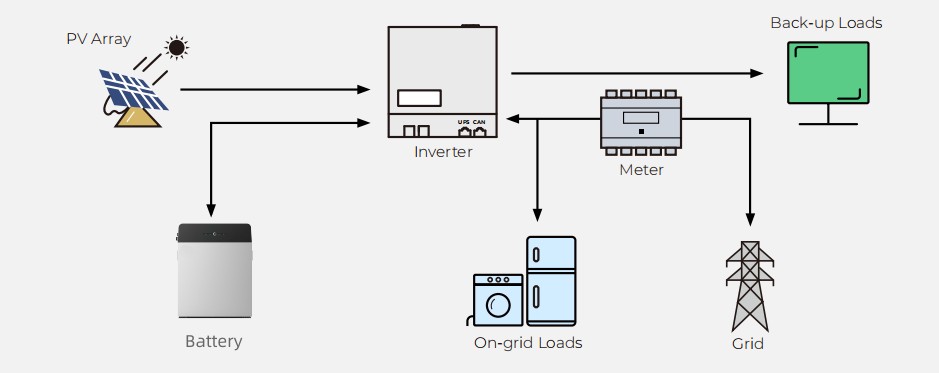
The structure of the household energy storage system includes: photovoltaic modules, energy storage batteries, energy storage inverters, grid-connected and metering equipment, public power grids, household loads and important loads, etc.
Working principle
1. In the morning, when the sunlight is sufficient, the PV energy is supplied to the load first, and the household load consumes the photovoltaic power generation to the greatest extent, and the remaining power will be stored by the battery; when the sunlight is insufficient, the battery supplements the power to the load.
2. In the afternoon, after the household load consumption is satisfied and the battery is fully charged, the remaining power will be fed to the grid. Power is used by important loads, secondly to charge batteries, and finally flows to household loads, and excess flows to the grid.
3. In the absence of sunlight, the battery is converted into AC power by the inverter for the load.
4. When the battery cannot meet the power demand of the load, the grid will supplement the power for the load.
FLY 5 kWh and 10 kWh batteries, matching the inverters of most mainstream manufacturers to meet the market demand for photovoltaic energy storage in most households.
Recent Posts




Contact US
Product Information
Quantity
Unit
Piece
Support order samples, customization, wholesale direct, and complete payment. If the product you look for does not have corresponding customized content, pls fill out the form below to contact us, and we will reply ASAP.